
by Jordi Cabre – Deming Collaboration
In the previous article ”Brief insight about the European Union Crisis”we argued that “The actual crisis has many causes, but its current continual worsening is due to additional errors that could have been avoided”
Not understanding root causes produces wrong solutions focused on symptoms. That is our problem.
One of the wrong reactions produced by the crisis, but also by the fear people and governments have, is the continual disagreements between countries that try to optimize their own conditions with no regard or vision for its effects on the whole Union. As Deming said long ago, this would destroy the system in the long term and in end all will lose, losers and apparent winners.
Today EU is not the common house we wanted, lack of collaboration is arising everywhere. Other wrong solution is to focus on public debt and deficit considering them as a main item to solve. It was clearly proved that deficit in Spain was surplus and debt below 40 % before the crisis. Much better than Germany or France. Surplus did not help Spain to overcome the crisis.
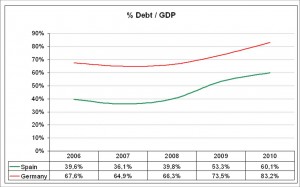
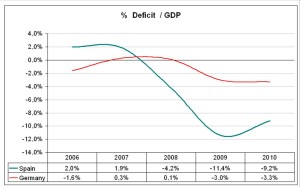
But the increase of the debt is not a cause, but a consequence of the governments decision to support private financial organizations by giving them liquidity and credit.
Nothing efficient has been done to improve inefficiency of the financial system. Even worse, efficient professionals and citizens are paying with reduction in their salaries, in social welfare, in education and in the health system. Some people even believe that we were spending above our possibilities. That’s not exactly true but it is the tale many north Europeans are told.
So, what was wrong? Why we are in a big crisis?
Let’s begin by saying that Lehman Brothers impact in EU, with subprime mortgages, followed by the European Rescue Plan of the financial system, (in Spain the 2008’s law “Rescue Plan of Financial organizations in Euro Countriesall them are consequences of a world wide misleading financial system. But they are only the catalyzes of a deeper root cause. Catalyzes just produce the explosion when they appear, but they are not the cause.
Most countries had a housing bubble, and in Spain this bubble changed the way of thinking of many people for decades. The root cause comes from long ago. Ten years ago nobody in Spain would believe that housing prices could fall down. That would be just unbelievable. With this wrong idea, investors found that their money grew more in the housing world than in anywhere else. If you have a little of money, just go and buy a flat, a house and you will get more than investing in business.
So in Spain, and specifically in Catalonia, where I know a bit closer, the money runs from industries to the housing, so making the bubble bigger and bigger. Most businessmen invested too in housing as it produced quicker and higher benefits than in their own business.
Everybody was focusing in getting higher returns from their money in the quickest possible way. Not matter whether this did not produce useful value. A requirement Deming would advise us. And bankers and financial lenders, lending more money for housing and also investing in a stock system that gives better benefits in the short term. Of course the banking executives got high salaries as they got their objectives with the quotas they had. Another misleading problem that Deming taught us.
What happens now? The industrial web has been damaged. Money and efficiency are now an important need. But money is not enough to make businesses competitive, they are in the same situation than Japan in the 1950,s. Management needs to understand that competitiveness and efficiency is the result of a different understanding, a never ending improvement of the industry, a continual learning to get new knowledge to take the right decisions with their organizations.Management in Spain must follow the path W. Edwards Deming taught the Japanese, and that was so successful. The same that the best companies do today.
It’s a long path to competitiveness, to export as Japanese do, it is not only about investing money, it is about getting a new positive way of running companies to make them efficient. And then yes, investor should invest in this kind of companies.
The solution is to change the way of thinking of management, of owners and entrepreneurs. Seminars and courses, books and articles, videos and many other things should be put available to help in this industrial revolution.
________________________________________
Jordi cabre is the founder of SIGEI Consulting, a Spanish Management consultancy in Barcelona based on Deming’s ideas and founder member of “LA PLATAFORMA – XXI Management Transformation Platform”, a non profit Foundation to improve organizations by sharing knowledge. Jordi graduated from the Polytechnic University of Barcelona with a degree as a Mechanical Industrial Engineer and pursued doctoral studies at the University of Valencia. He has taken many courses and seminars on quality, management, and consulting.
His professional career began in 1977, in the UK with Lucas Automotive Group in tests research and product development. He moved to the Spanish manufacturing plant in Barcelona as Manufacturing Quality Manager.
 From 1981 to 1995 he worked for IBM, where he was Director of Procurement, Quality and Process Improvement. His team implemented a new quality approach reducing inspection while improving processes and organization, creating a new collaborative approach with suppliers, inspired by W. Edwards Deming. During this period the Spanish Plant obtained the highest IBM worldwide quality recognition. Later on his responsibilities switched to Consultancy Director for Quality Systems and Process Improvements.
Jordi enjoys helping all kind of organizations increase profits by continually improving internal and external quality, identifying organizational and processes potential improvement opportunities, strategic planning and deployment, risk assessments, statistic studies and training. In addition he has extensive in depth knowledge of the technology and data processing industries.
He is active in management research and is continually deepening and increases his understanding of Deming’s ideas which he applies with great knowledge to revitalize organizations.